Laparoscopic Surgical Robot
A handheld, detachable laparoscopic tool. The research coordinates wire-driven bending and rotation through embedded motor control.
Method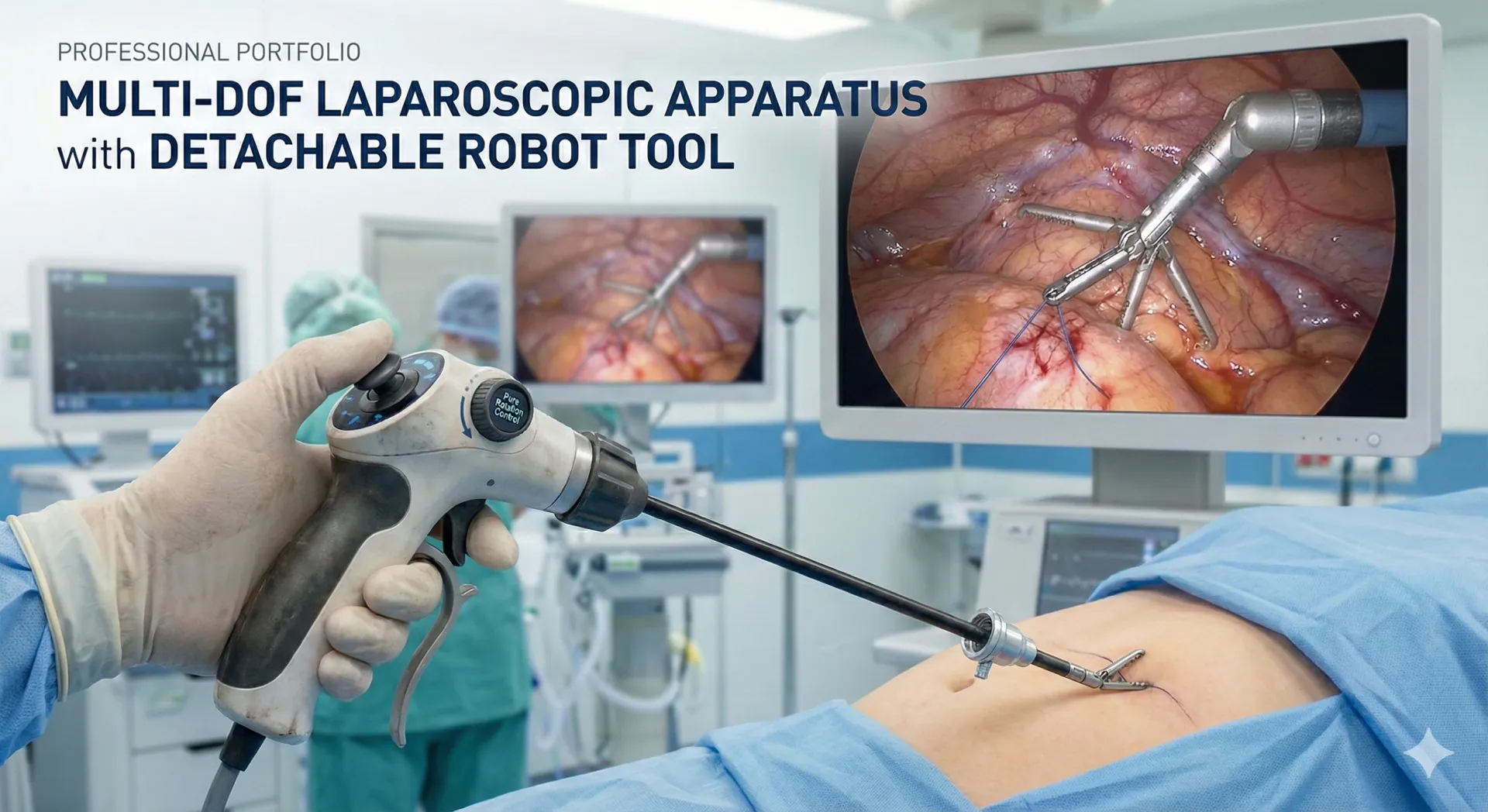
Research question
How can a bent tool rotate without losing its bend?
The research joins handheld inputs, a wire-driven mechanism and coordinated motor control. The difficult part is preserving the intended motion when bending and rotation interact.
Method
Different inputs. Coordinated motion.
- Joystick
- Bending
Set the bend direction
Directional input controls the tool's up/down and left/right bending.
- Dial + encoder
- Axial rotation
Request axial rotation
The encoder reads the rotary dial; control coordinates rotation with the existing bend.
- Trigger + Hall sensor
- Opening / closing
Open or close the tip
The Hall sensor detects trigger movement as an input to the end-effector control.
Design choices
What the design had to account for.
Separate the requested motion from individual motors
A user requests bending, rotation or opening. The controller translates those inputs into coordinated motor movement.
Preserve the bend during rotation
The development record describes coordinating the bending and rotation motors and compensating for wire-driven mechanics, rather than assuming the axes are mechanically independent.
Keep the tool attachment distinct from the control body
The detachable interface separates the handheld control body from the surgical tool. Input devices, motors and attachment constraints have different responsibilities.
Research record
An invention with a public record.
The published patent names 김건우 and 진상록 as inventors and 부산대학교 산학협력단 as the original assignee. The document describes the handheld controls, detachable interface and coordinated bending and rotation.
The patent supports attribution and the described mechanism. It is not evidence of clinical outcomes, medical-device approval or measured control performance.
Reference material
- Publication
- KR102199910B1
- Inventors in the record
- 김건우 · 진상록
- Published
- 2021.01.07
Description and claims 1, 8 and 9: input mapping, controller and detachable tool interface.
Read the technical notes
Input and control
The joystick, rotary dial/encoder and trigger/Hall sensor provide distinct inputs. The control board receives them and drives the motor arrangement described in the patent.
Wire-driven mechanics
The development notes describe wire-length compensation and hysteresis handling. Rotation and bending are coordinated to preserve the requested bent posture.
Attachment boundary
The patent describes mounting and detachment of the tool. The handheld input assembly and the tool interface are treated separately in the engineering account.
Tools and methods
- Embedded C
- Real-time Control
- Kinematics Algorithm
- Servo Motor Control
- Sensor Fusion